Tuesday, June 13, 2017

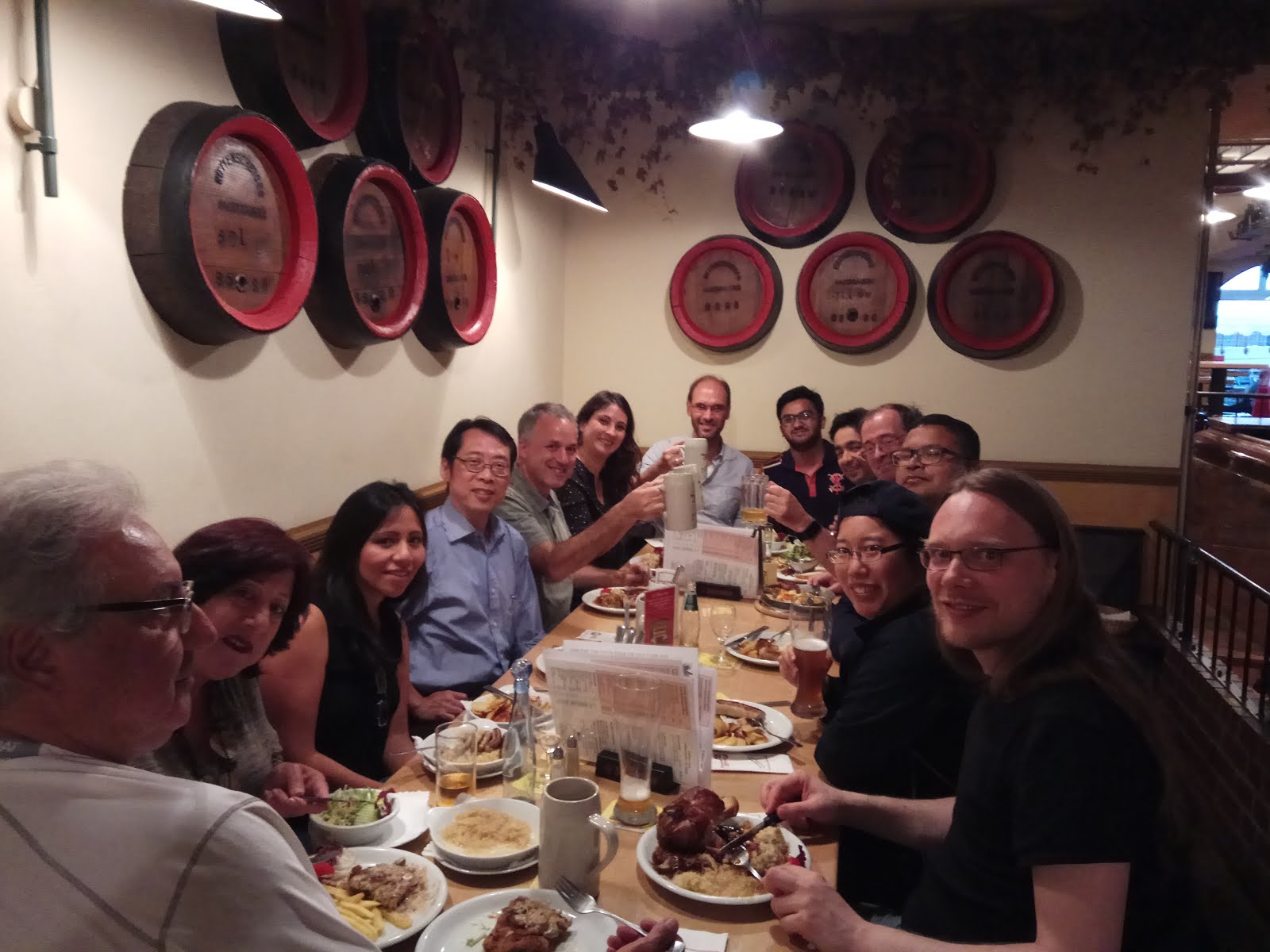
iStar 2017 is over, we will see you next year!!!


This has been a special edition of the workshop, it has been a pleasure chairing the 10th iStar workshop with Lin Liu and Sepideh Ghavanati. 

 iStar 2017 Workshop
This year has been a really nice workshop, we had 17 papers, 12 regular presentations and 5 short presentations. The organization committee wanted to celebrate the 10th anniversary having a really interactive workshop, so we had 2 keynotes and two panels. All of it distributed in a 2-day workshop. 


We also have to say that we had a good time in Essen.


Remember that the proceedings are available at CEUR-WS (Vol. 1829): http://ceur-ws.org/Vol-1829/

Thank you the steering committee for choosing me as part of the organization committee and all the authors for choosing iStar 2017 to share their work.


Friday, April 28, 2017

Paper accepted at the 10th International i* Workshop (iStar 2017)


Dealing with Goal Models Complexity using Topological Metrics and Algorithms

Lucía Méndez Tapia, Lidia López , Claudia P. Ayala


Abstract. The inherent complexity of business goal-models is a challenge for
organizations that has to analyze and maintaining them. Several approaches are
developed to reduce the complexity into manageable limits, either by providing
support to the modularization or designing metrics to monitor the complexity
levels. These approaches are designed to identify an unusual complexity
comparing it among models. In the present work, we expose two approaches
based on structural characteristics of goal-model, which do not require these
comparisons. The first one ranksthe importance of goalsto identify a manageable
set of them that can be considered as a priority; the second one modularizes the
model to reduce the effort to understand, analyze and maintain the model.

 iStar 2017CAISE 2017

Co-located to the 29th International Conference on Advanced Information Systems Engineering.

Sunday, December 4, 2016

iStar 2017 workshop at CAiSE

This year I'm organising the International Workshop of i* jointly to Lin Liu and Sepideh Ghanavati. You can find the workshop details at iStar17 website.

The workshop will be co-located to the 29th International Conference on Advanced Information Systems Engineering (CAiSE'17).


 CAiSE 2017

Tuesday, November 1, 2016

Q-Rapids European Research Project starts

Q-Rapids: Quality-aware rapid software development

H2020 (H2020-ICT-2016-1, Software Technologies)


The 3-year Q-Rapids defines an empirical-based, data-driven quality-aware rapid software development methodology.
Quality Requirements (QRs) are incrementally elicited and refined based on data gathered both during development and at runtime. This data is elaborated into quality-related key indicators presented to decision makers through a strategic dashboard with advanced capabilities. Selected QRs are integrated with functional requirements for their unified treatment in the rapid software development process.


More information at www.q-rapids.eu

Wednesday, September 7, 2016

Today arrived a printed copy of my first book chapter

Surprisingly, yesterday arrived a printed copy of my first book chapter. I'm not sure who send it to me, so I don't know who to thank you.

The i* framework for goal-oriented modeling

Xavier Franch, Lidia Lopez, Carlos Cares and Daniel Colomer

Abstract. i* is a widespread framework in the software engineering field that supports goal-oriented modeling of socio-technical systems and organizations. At its heart lies a language offering concepts such as actor, dependency, goal and decomposition. i* models resemble a network of interconnected, autonomous, collaborative and dependable strategic actors. Around this language, several analysis techniques have emerged, e.g. goal satisfaction analysis and metrics computation. In this work, we present a consolidated version of the i* language based on the most adopted versions of the language. We define the main constructs of the language and we articulate them in the form of a metamodel. Then, we implement this version and a concrete technique, goal satisfaction analys is based on goal propagation, using ADOxx. Throughout the chapter, we used an example based on open source software adoption to illustrate the concepts and test the implementation.


ISBN: 978-3-319-39416-9 (Print) 978-3-319-39417-6 (Online)

The final publication is available at Springer via http://dx.doi.org/10.1007/978-3-319-39417-6